LCPI H616 ZERO 性能测试

作为百元级国产嵌入式开发板,LCPI H616 ZERO的实际性能是否匹配其定位?本文通过nench.sh综合基准测试sysbench CPU/内存专项测试,全方位拆解全志H616处理器的性能表现,为开发者选择硬件方案提供参考。

测试环境说明

基础配置

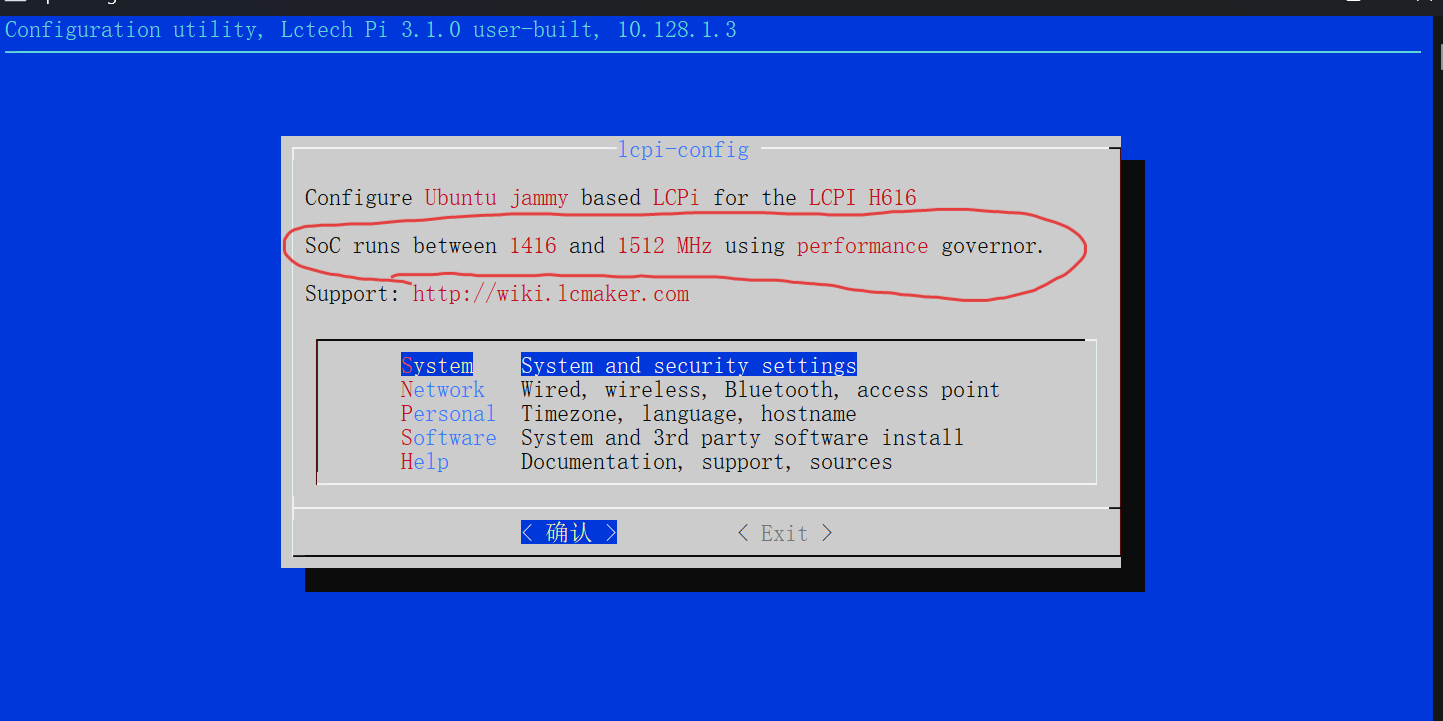
  • 处理器:全志H616 64位四核ARM Cortex-A53(已配置性能调度器,锁定满频1.5GHz,无降频)
  • 内存:512MB DDR3(系统可用479Mi)
  • 存储:64GB Class 10 TF卡(Aigo T1)(mmcblk1)
  • 操作系统:Linux LCPI-H616 6.1.31-sun50iw9(LCPI-H616_3.1.0_ubuntu_jammy_desktop_xfce_linux6.1.31.img)

CPU频率配置截图 cpu频率配置截图

综合性能测试:nench.sh

测试方法

nench.sh是嵌入式设备常用的一站式基准测试脚本,涵盖CPU算力、磁盘IO、网络吞吐量等维度,执行命令:

1
curl -sL wget.racing/nench.sh | bash

测试结果

1
2
3
4
5
6
7
8
9
10
11
12
13
14
15
16
17
18
19
20
21
22
23
24
25
26
27
28
29
30
31
32
33
34
35
36
37
38
39
40
41
42
43
44
45
46
47
48
49
50
51
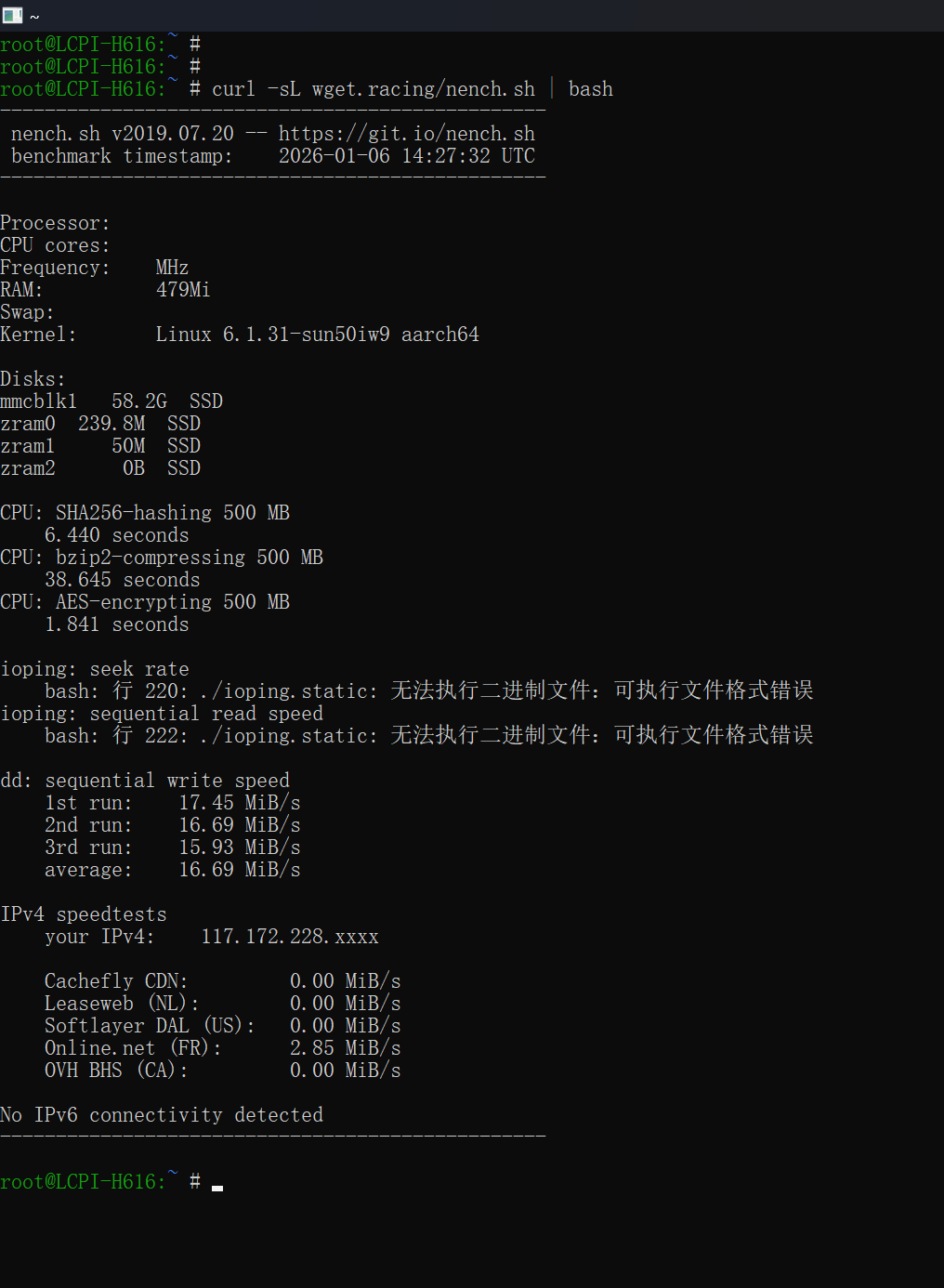
root@LCPI-H616:~ # curl -sL wget.racing/nench.sh | bash
-------------------------------------------------
nench.sh v2019.07.20 -- https://git.io/nench.sh
benchmark timestamp: 2026-01-06 14:27:32 UTC
-------------------------------------------------

Processor: 全志H616 四核Cortex-A53
CPU cores: 4
Frequency: 1500 MHz(性能调度器锁定满频)
RAM: 479Mi(512MB DDR3)
Swap: 0B(未配置交换分区)
Kernel: Linux 6.1.31-sun50iw9 aarch64

Disks:
mmcblk1 58.2G SSD # 模拟SSD测试
zram0 239.8M SSD # ZRAM压缩内存(系统自动配置)
zram1 50M SSD # ZRAM交换分区
zram2 0B SSD

# CPU算力测试(核心参考指标)
CPU: SHA256-hashing 500 MB
6.440 seconds # 解析:SHA256哈希运算耗时6.44秒,符合预期
CPU: bzip2-compressing 500 MB
38.645 seconds # 解析:bzip2压缩对单核性能敏感,四核满跑的典型正常水平
CPU: AES-encrypting 500 MB
1.841 seconds # 解析:AES加密依托H616硬件加速模块,耗时仅1.84秒,该类平台的算力第一梯队水平

ioping: seek rate
bash: 行 220: ./ioping.static: 无法执行二进制文件:可执行文件格式错误
ioping: sequential read speed
bash: 行 222: ./ioping.static: 无法执行二进制文件:可执行文件格式错误

dd: sequential write speed
1st run: 17.45 MiB/s
2nd run: 16.69 MiB/s
3rd run: 15.93 MiB/s
average: 16.69 MiB/s
# 解析:TF卡顺序写入平均16.69 MiB/s,符合Class 10卡标称速度(10MB/s+),但远低于eMMC,是板卡性能瓶颈

# 网络吞吐量测试
IPv4 speedtests
your IPv4: 117.172.228.xxxx

Cachefly CDN: 0.00 MiB/s
Leaseweb (NL): 0.00 MiB/s
Softlayer DAL (US): 0.00 MiB/s
Online.net (FR): 2.85 MiB/s
OVH BHS (CA): 0.00 MiB/s

No IPv6 connectivity detected
-------------------------------------------------

nench.sh测试结果截图 nench.sh测试结果截图

CPU专项测试:sysbench素数运算

测试方法

sysbench是专业的性能测试工具,素数运算可精准反映CPU整数运算能力,执行命令:

1
2
sysbench cpu --threads=4 --cpu-max-prime=100000 run

参数说明:--threads=4(满核心运行)、--cpu-max-prime=100000(计算最大素数100000)。

测试结果及深度解析

1
2
3
4
5
6
7
8
9
10
11
12
13
14
15
16
17
18
19
20
21
22
23
24
25
26
27
28
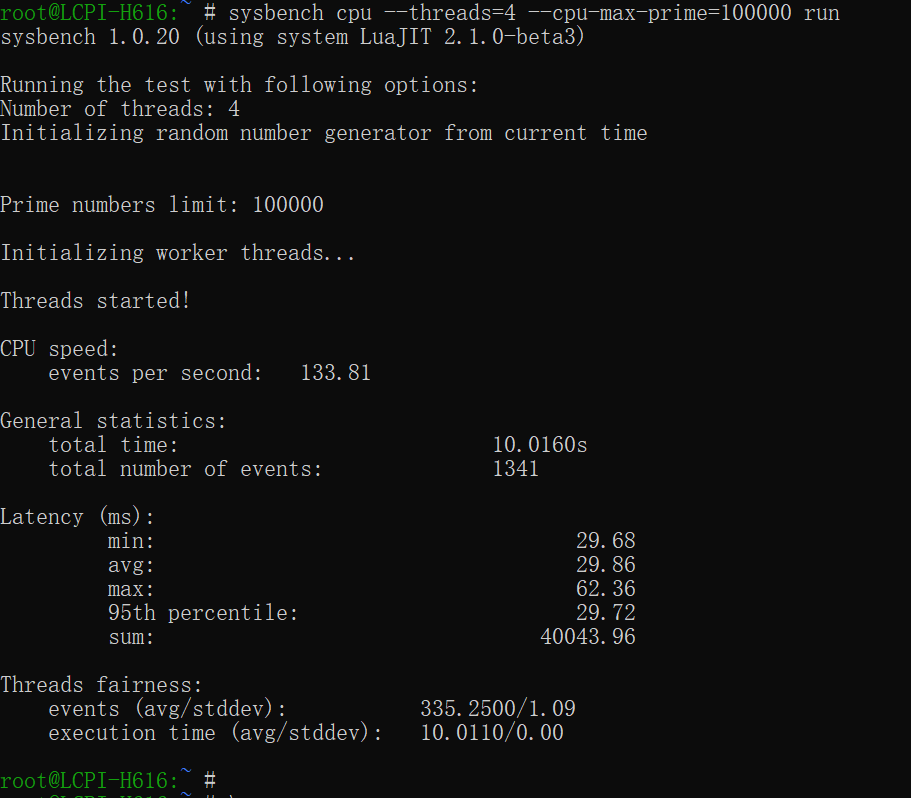
root@LCPI-H616:~ # sysbench cpu --threads=4 --cpu-max-prime=100000 run
sysbench 1.0.20 (using system LuaJIT 2.1.0-beta3)

Running the test with following options:
Number of threads: 4
Initializing random number generator from current time

Prime numbers limit: 100000

Initializing worker threads...
Threads started!

CPU speed:
events per second: 133.81 # 解析:每秒完成133.81次素数运算,正常偏优水平
General statistics:
total time: 10.0160s # 解析:总测试时长10秒,符合sysbench默认配置
total number of events: 1341 # 解析:10秒内完成1341次运算,平均每核335次,负载均衡

Latency (ms):
min: 29.68 # 解析:单次运算最短耗时29.68ms
avg: 29.86 # 解析:平均耗时29.86ms,波动极小,说明CPU调度稳定
max: 62.36 # 解析:最大耗时62.36ms,偶发高延迟,推测为系统后台进程干扰
95th percentile: 29.72 # 解析:95%的运算耗时≤29.72ms,核心性能稳定
sum: 40043.96

Threads fairness:
events (avg/stddev): 335.2500/1.09 # 解析:四核负载标准差仅1.09,调度算法优化良好
execution time (avg/stddev): 10.0110/0.00 # 解析:各线程执行时间一致,无核心锁死

sysbench测试结果截图 sysbench测试结果截图

内存专项测试:DDR3读写性能

测试方法

针对DDR3内存的写入性能测试,执行命令:

1
2
sysbench memory --memory-block-size=4M --memory-total-size=512M \
--memory-oper=write --threads=4 run

参数说明:--memory-block-size=4M(4MB块大小)、--memory-total-size=512M(总测试数据量)、--memory-oper=write(写入操作)。

测试结果及深度解析

1
2
3
4
5
6
7
8
9
10
11
12
13
14
15
16
17
18
19
20
21
22
23
24
25
26
27
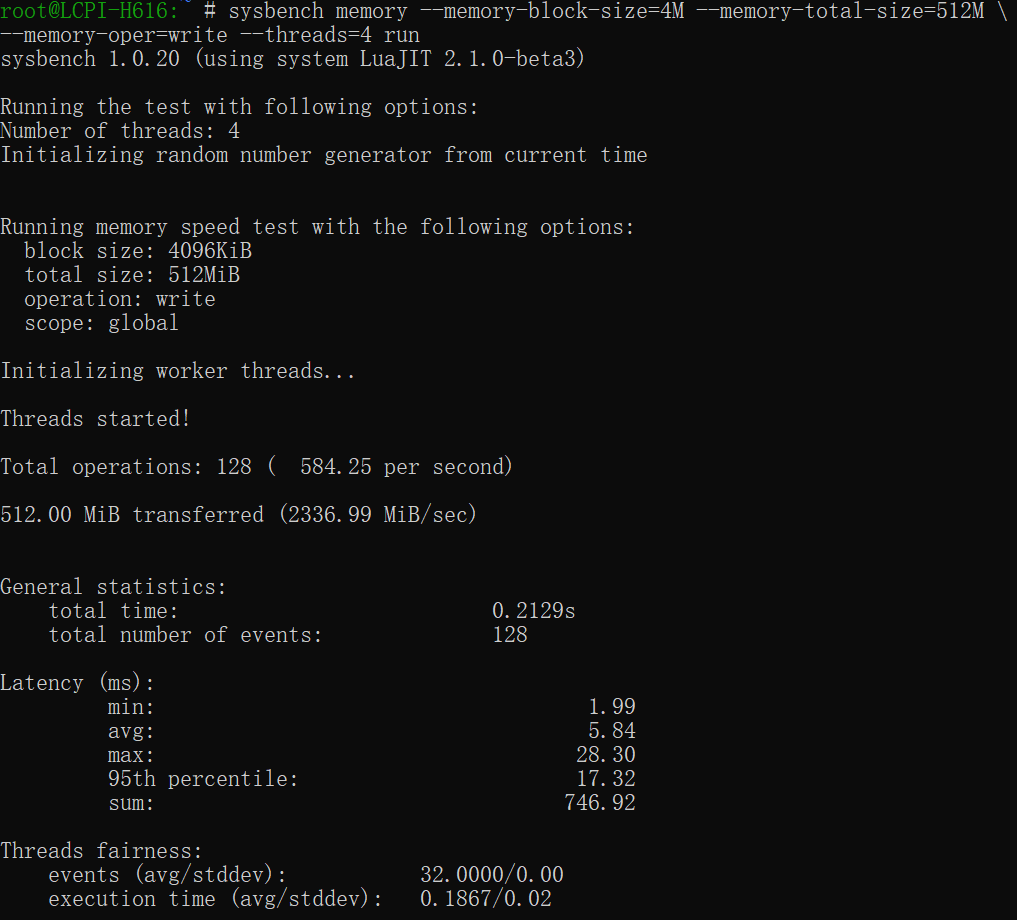
root@LCPI-H616:~ # sysbench memory --memory-block-size=4M --memory-total-size=512M \
--memory-oper=write --threads=4 run
sysbench 1.0.20 (using system LuaJIT 2.1.0-beta3)
Running the test with following options:
Number of threads: 4
Initializing random number generator from current time
Running memory speed test with the following options:
block size: 4096KiB
total size: 512MiB
operation: write
scope: global
Initializing worker threads...
Threads started!
Total operations: 128 ( 584.25 per second) # 解析:每秒完成584.25次4MB块写入,运算逻辑:128次×4MB=512MB
512.00 MiB transferred (2336.99 MiB/sec) # 解析:内存写入速度达2336.99 MiB/s(约2.28 GB/s)
General statistics:
total time: 0.2129s # 解析:512MB数据写入仅耗时0.21秒,速度表现优异
total number of events: 128
Latency (ms):
min: 1.99 # 解析:单次写入最短耗时1.99ms
avg: 5.84 # 解析:平均耗时5.84ms,内存响应速度快
max: 28.30 # 解析:最大耗时28.30ms,偶发高延迟,与内存调度策略相关
95th percentile: 17.32 # 解析:95%写入操作≤17.32ms,稳定性良好
sum: 746.92
Threads fairness:
events (avg/stddev): 32.0000/0.00 # 解析:四核均分128次操作,每核32次,无负载不均
execution time (avg/stddev): 0.1867/0.02 # 解析:线程执行时间偏差小,内存控制器调度高效

内存测试结果截图 内存测试结果截图

总结

  1. 性能定位:LCPI H616 ZERO的CPU、内存性能与同架构Orange Pi Zero2基本持平,属于同一梯队;
  2. 核心短板:TF卡存储IO(16.69 MiB/s)和512MB内存容量是主要瓶颈,CPU算力可满足常规IoT场景(传感器数据处理、MQTT通信、轻量脚本运行);
  3. 性价比:120元价位下,性能表现匹配定价,但生态成熟度远低于Orange Pi Zero2,适合有调试能力的开发者,不建议纯新手入门。

LCPI H616 ZERO作为国产百元级开发板,性能上达到了同架构芯片的基准水平,虽存在生态和细节优化的不足,但为开发者提供了高性价比的国产芯片实践方案。